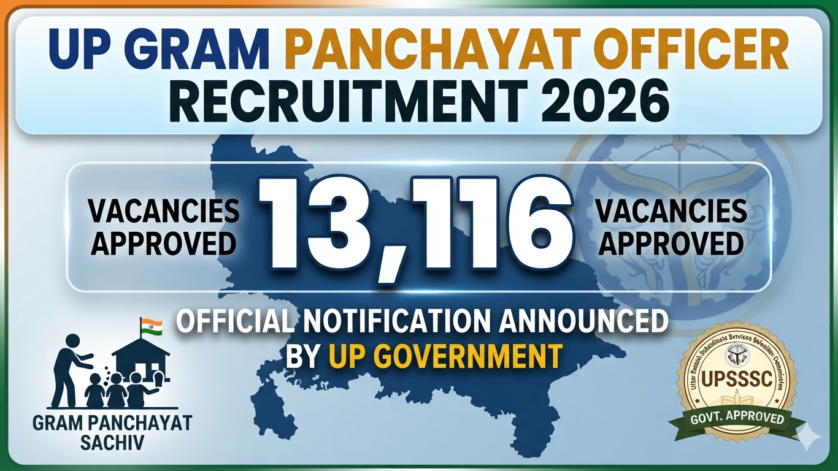
The Uttar Pradesh government has officially approved the creation and recruitment proposal for 13,116 new Gram Panchayat Officer (Gram Panchayat Sachiv) posts. This historic decision, finalized during a high-level meeting of the Panchayati Raj Department, aims to completely restructure and modernize rural governance across the state. By introducing these new positions, the state administration is moving rapidly toward implementing its landmark policy of “One Panchayat, One Secretary,” ensuring that every single village administrative unit has its own dedicated oversight officer.
For lakhs of job seekers across Uttar Pradesh, this monumental approval marks one of the largest mega-recruitment drives in the rural development sector. The recruitment will be executed by the Uttar Pradesh Subordinate Services Selection Commission (UPSSSC) in a systematic, phased manner stretching over the next three years.
Key Highlights of UP Gram Panchayat Officer Recruitment 2026
- Total Sanctioned Posts: 13,116 vacancies approved for creation.
- Phased Implementation: The recruitment drive will occur across three distinct phases over three consecutive years.
- First Phase Openings: 4,372 posts will be created and filled immediately in the first phase.
- Core Objective: Eliminating additional charge arrangements and enforcing the “One Panchayat, One Secretary” rule.
- Exam Conducting Authority: Uttar Pradesh Subordinate Services Selection Commission (UPSSSC).
- Primary Requirement: Selection will likely require a valid UP Preliminary Eligibility Test (PET) score, alongside standard intermediate and computer qualifications.
The Governance Crisis: Why 13,116 New Posts Are Needed
To understand the scale and necessity of this recruitment drive, one must look at the current administrative data of Uttar Pradesh’s rural areas. Uttar Pradesh is home to approximately 58,000 Gram Panchayats. However, the state currently operates with an active workforce of only about 16,000 Gram Panchayat Officers (VPOs) and Village Development Officers (VDOs) combined.
The Additional Charge Dilemma
Because of this stark deficit, more than 42,000 Gram Panchayats are operating without a dedicated, full-time secretary. To keep the administrative machinery moving, the department has been forced to allocate multiple village clusters to single officers.
- Work Overload: It is common for a single Gram Panchayat Officer to hold the additional charge of three to five distinct villages simultaneously.
- Delayed Public Services: Because an officer can only visit a specific village one or two days a week, basic citizen services—such as issuing birth, death, and income certificates—experience significant backlogs.
- Stagnant Fund Utilization: Central and state welfare budgets allocated via the Finance Commission often face delays in deployment because a single individual cannot physically monitor development projects across multiple geographical jurisdictions.
The approval of the 13,116 vacancy proposal directly addresses these pain points. By placing a dedicated official in each village, the state will establish a highly accountable, responsive localized administration.
Phased Recruitment Roadmap (2026–2028)
The State Executive Committee, under the chairmanship of the Chief Secretary and with explicit concurrence from the Finance and Rural Development Departments, determined that a single massive hiring cycle could overwhelm training and onboarding infrastructures. Therefore, the 13,116 vacancies are strictly divided into three annual, equal tranches:
[Total Approved Vacancies: 13,116]
        │
        ├── Phase 1 (2026): 4,372 Posts (Approved & Moving to Notification)
        │
        ├── Phase 2 (2027): 4,372 Posts (Subsequent Annual Tranche)
        │
        └── Phase 3 (2028): 4,372 Posts (Final Implementation Block)
The Principal Secretary of the Panchayati Raj Department confirmed that the formal proposal for Phase 1 has been forwarded to the Finance Department for immediate monetary allocation and official post-creation clearance. Once this budget vetting is finalized, the requisition file will be handed over to UPSSSC to release the Phase 1 notification.
Clarification on Cadre Integration: VPO vs. VDO
A critical institutional debate took place during the high-level departmental discussions regarding whether to merge the Gram Panchayat Officer (VPO) cadre under the Panchayati Raj Department and the Village Development Officer (VDO) cadre under the Rural Development Department into a single, unified administrative cadre.
Following exhaustive evaluation, the proposal to create a unified cadre was officially rejected.
- Distinct Jurisdictions: Both cadres will maintain their independent structural identities, operational hierarchies, and promotion tracks.
- Independent Operations: The Rural Development Department remains completely free to independently assess, create, and advertise new VDO posts based on its unique departmental requirements, completely separate from this VPO recruitment drive.
- Inter-Departmental Allocation: To seamlessly execute the “One Secretary” program, a specialized separate allocation blueprint will be drawn up and presented directly to Chief Minister Yogi Adityanath to define how VPOs and existing VDOs will split operational custody of the state’s 58,000 villages.
Expected Eligibility Criteria & Qualifications
While the definitive, itemized rules will be made public when UPSSSC uploads the official notification, the recruitment rules will align with the standardized structural framework of the UP Subordinate Services Rules.
1. Educational Qualifications
- Intermediate (Class 12th): Applicants must have successfully cleared their 10+2 high school examinations from a government-recognized education board.
- Computer Certification: Candidates must possess a valid NIELIT CCC (Course on Computer Concepts) certificate or an equivalent government-approved IT qualification, as the modern VPO role relies heavily on digital governance portals.
2. The Mandate of the UP SSV / PET Exam
Because this position falls squarely within Group ‘C’ state public service parameters, a valid UPSSSC Preliminary Eligibility Test (PET) scorecard is mandatory.
- Candidates will be shortlisted for the main written examination based on their normalized percentile scores in the PET exam.
- High cutoff scores are anticipated due to the sheer volume of candidates vying for these stable state positions.
3. Age Limit Parameters
- Minimum Age: 18 Years
- Maximum Age: 40 Years
- Relaxation Allowances: Age relaxations for Scheduled Castes (SC), Scheduled Tribes (ST), Other Backward Classes (OBC), Persons with Disabilities (PwD), and Ex-Servicemen will apply per current Uttar Pradesh state government reservation directives.
Step-by-Step Selection Process
The UPSSSC will execute a rigorous, multi-tiered screening matrix to select the most capable candidates for rural management:
[Step 1: PET Score Shortlisting]
               │
               ▼
[Step 2: Main Written Examination (Subject-Specific)]
               │
               ▼
[Step 3: Document Verification (DV) & Merit Matching]
               │
               ▼
[Step 4: Mandatory Institutional Training Induction]
- PET Shortlisting: Initial applications are filtered, and candidates are selected to sit for the main exam at an approximate ratio of 15 to 45 times the number of phase-specific seats.
- Main Written Examination: A comprehensive offline or online objective test explicitly focusing on rural governance, public administration, financial rules of panchayats, and basic information technology infrastructure.
- Document Verification (DV): Thorough validation of identity, educational transcripts, caste credentials, and mandatory computer certificates.
- Final Merit List: Compilation of final selections based entirely on the marks secured in the Main Written Examination.
Expected Syllabus and Exam Blueprint
Based on historical UPSSSC trends for Gram Panchayat Officer selections, the written examination will place immense weight on rural governance mechanisms rather than generic aptitude topics. The exam typically spans 100 marks across a 2-hour duration:
| Exam Core Segment | Expected Weightage / Marks | Core Areas Covered |
|---|---|---|
| Panchayati Raj System History & Laws | 30 Marks | Constitutional 73rd Amendment, evolution of rural bodies, UP Panchayati Raj Act. |
| Financial & Gram Panchayat Schemes | 20 Marks | Central/State schemes (MNREGA, PMAY-G), asset registers, village budget preparation. |
| Rural Development & VPO Roles | 15 Marks | Duties of a secretary, coordination with line departments, birth/death registration frameworks. |
| General Computer & IT Knowledge | 15 Marks | Digital India initiatives, e-Gram Swaraj portal, basic hardware/software, internet security. |
| Uttar Pradesh General Knowledge | 20 Marks | Geography, economy, history, culture, and current administrative updates of UP. |
Job Profile and Core Responsibilities of a Panchayat Secretary
A Gram Panchayat Officer serves as the primary administrative bridge connecting the rural population with the state apparatus. They function as the official member secretary of the Gram Panchayat, collaborating closely with the elected Gram Pradhan.
- Financial Oversight & Account Management: Preparing the annual village budget, maintaining accurate cash books via online accounting portals like e-Gram Swaraj, and overseeing fund co-signatures alongside the Gram Pradhan.
- Welfare Scheme Execution: Identifying eligible rural beneficiaries for critical social security programs, such as old-age, widow, and disability pensions, as well as checking housing allocations under the Pradhan Mantri Awas Yojana.
- Public Infrastructure Maintenance: Supervising the execution of village development projects, including constructing concrete internal roads (Kharanja), setting up drainage lines, installing solar streetlights, and renovating local school buildings.
- Civil Registration Functions: Acting as the local registrar tasked with accurately logging vital statistics, including issuing formal birth, death, and marriage certificates.
- Gram Sabha Assembly Coordination: Organizing and documenting periodic Gram Sabha meetings to ensure public participation in finalising village development priorities.
Salary Structure, Perks, and Career Trajectory
The position of a Gram Panchayat Officer provides an attractive pay structure alongside excellent job security and long-term career growth within the Panchayati Raj structure of Uttar Pradesh.
- Pay Scale Classification: Group ‘C’
- Pay Matrix Level: Level 3 (As per the 7th Central Pay Commission recommendation Framework)
- Core Pay Band: ₹21,700 to ₹69,100
- Initial Grade Pay: ₹2,000
- Allowances: Appointed officers receive standard Dearness Allowance (DA), House Rent Allowance (HRA) based on location, and specialized traveling allowances designed to cover field commutes within rural clusters.
Career Progression Path
An ambitious officer entering the department as a Gram Panchayat Officer can access clear promotions over their tenure:
[Gram Panchayat Officer (Entry Level)]
                  │
                  ▼
      [Assistant Development Officer (ADO - Panchayat)]
                  │
                  ▼
         [District Panchayati Raj Officer (DPRO)]
Impact of the Recruitment on UP’s Rural Landscape
The formal approval of these 13,116 positions is more than just a massive employment announcement; it represents an essential administrative upgrade for northern India’s rural economy.
1. Instant Acceleration of Grassroots Development
With a dedicated secretary permanently on-site, administrative bottlenecks disappear overnight. Village files will no longer languish on desks waiting for an officer to finish their rotational duties in another district, leading to much faster project turnaround times.
2. Unprecedented Digital Transparency
The government’s primary hurdle in digitizing rural records has been the digital illiteracy or total absence of physical field personnel. Deploying tech-savvy, computer-certified VPOs across all panchayats will ensure that rural audit frameworks, online expense tracking, and geo-tagging of village infrastructure are updated in real-time.
3. Resolving the Unemployment Crunch
By injecting thousands of secure public-sector jobs into the economy over three years, this recruitment drive offers a significant career option for educated rural youths who hold valid UPSSSC PET scores but lack local employment venues.
Preparation Strategy for Aspiring Candidates
Given the high level of competition for state government jobs in Uttar Pradesh, prospective applicants must start preparing well before the formal notification drops.
- Master the Panchayati Raj Act: Do not treat this as a standard aptitude test. Dive deep into the specific administrative rules, historical evolution, and legal amendments governing local self-government in India.
- Stay Updated on Rural Schemes: Regularly review the official tracking portals of the Ministry of Rural Development and the Panchayati Raj Department to learn about funding allocations, implementation rules, and performance metrics.
- Refine UP-Specific Knowledge: Secure specialized study guides focusing heavily on the socio-economic geography, historic achievements, and structural governance maps unique to Uttar Pradesh.
- Maintain High PET Percentiles: Ensure your foundational concepts remain strong so you can consistently score in the top tiers of the annual UPSSSC Preliminary Eligibility Tests, keeping you eligible for all forthcoming main exam calls.
Here are the most frequently asked questions regarding the UP Gram Panchayat Officer (VPO) Recruitment 2026 and the newly approved 13,116 vacancy proposal:
Vacancy & Implementation FAQs
Q: When will the official notification for the 13,116 VPO posts be released?
A: The Panchayati Raj Department has formally approved the creation of these posts. The proposal has been forwarded to the Finance Department for budget clearance. Following this vetting, the file will be handed over to the UPSSSC, which is expected to issue the formal notification for Phase 1 (4,372 posts) later this year.
Q: Will all 13,116 vacancies be filled at the same time?
A: No. To ensure smooth onboarding and training, the recruitment will be rolled out in a phased manner over three consecutive years. Each phase will advertise and recruit exactly 4,372 posts.
Q: What is the “One Panchayat, One Secretary” policy?
A: Currently, due to a severe shortage of personnel, one Gram Panchayat Officer often holds the additional charge of three to five villages. This policy ensures that every single Gram Panchayat in Uttar Pradesh gets its own dedicated, full-time secretary to eliminate delays in rural development.
Eligibility & Qualifications FAQs
Q: Is a UPSSSC PET scorecard mandatory for this recruitment?
A: Yes. Because the Gram Panchayat Officer is a Group ‘C’ state public service position, candidates must possess a valid UPSSSC Preliminary Eligibility Test (PET) scorecard. Candidates will be shortlisted for the main written exam based on their PET percentile.
Q: Can I apply if I have cleared intermediate (12th) but do not have a computer certificate?
A: No. A valid NIELIT CCC (Course on Computer Concepts) certificate (or a government-recognized equivalent IT qualification) is a mandatory requirement alongside your 10+2 high school credentials.
Q: What is the age limit to apply for the VPO post?
A: The standard age limit is 18 to 40 years. Relaxations in the upper age limit apply to SC, ST, OBC, PwD, and Ex-Servicemen categories according to Uttar Pradesh state government reservation rules.
Cadre & Exam Structure FAQs
Q: Are the VPO (Gram Panchayat Officer) and VDO (Village Development Officer) cadres being merged?
A: No. The high-level committee officially rejected the proposal to merge these cadres. They will remain separate identities under their respective departments (Panchayati Raj and Rural Development), with independent promotion tracks.
Q: What is the expected selection process?
A: The selection follows a strict four-step process:
- Shortlisting based on UPSSSC PET scores.
- Clearing the Main Written Examination.
- Passing Document Verification (DV).
- Completing mandatory Institutional Training.
Q: What subjects are covered in the main written exam?
A: The exam focuses heavily on rural governance rather than general aptitude. Key subjects include the History and Laws of the Panchayati Raj System, Central/State Rural Welfare Schemes, Roles of a VPO, General Computer & IT Knowledge, and Uttar Pradesh General Knowledge.
Salary & Job Profile FAQs
Q: What is the salary structure of a Gram Panchayat Officer in UP?
A: It is a Level 3 post (7th Pay Commission) with a core pay band of ₹21,700 to ₹69,100 and an initial Grade Pay of ₹2,000. Officers also receive standard state allowances like DA, HRA, and field traveling allowances.
Q: What are the primary duties of a VPO?
A: A VPO acts as the secretary of the Gram Panchayat. Core duties include preparing village development budgets, managing accounts on the e-Gram Swaraj portal, executing welfare schemes (like MNREGA and PMAY-G), and issuing birth/death certificates.
UP Gram Panchayat Officer Recruitment 2026, UP Gram Panchayat Sachiv vacancy, UPSSSC VPO notification 2026, Gram Panchayat Secretary eligibility UP, UPSSSC PET cutoff for VPO, One Panchayat One Secretary UP, UP Panchayati Raj recruitment, VPO salary in UP
UPGovernmentJobs, #UPSSSC, #GramPanchayatOfficer, #VPORecruitment2026, #SarkariNaukri, #UPJobs, #PanchayatSachivBharti
Hi, this is a comment.
To get started with moderating, editing, and deleting comments, please visit the Comments screen in the dashboard.
Commenter avatars come from Gravatar.